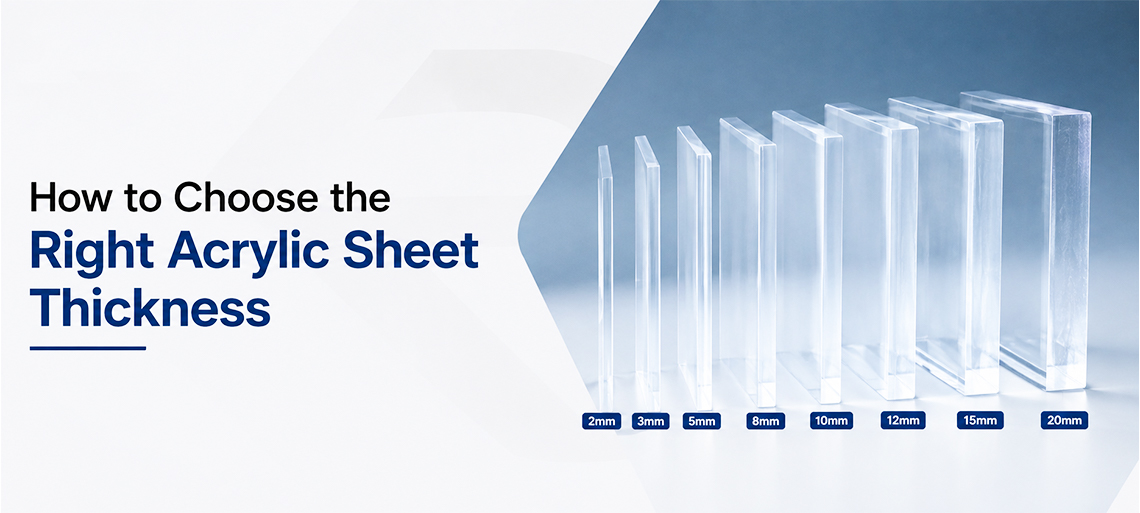
Selecting the right acrylic sheet thickness is one of the most important decisions when planning a fabrication, construction, or display project. Thickness directly affects strength, flexibility, weight, machining performance, and overall durability. Choosing a sheet that is too thin can lead to bending or cracking, while selecting an unnecessarily thick sheet may increase material costs and fabrication time. Understanding how thickness relates to the intended application helps achieve better performance and longer service life.
The first step in choosing the correct acrylic sheet thickness is identifying where and how the sheet will be used. Indoor display panels, signboards, protective covers, partitions, furniture, machine guards, and skylights all have different performance requirements. A decorative application may only require a thinner acrylic sheet, where greater rigidity or resistance to bending is required, thicker sheets may be more suitable.
Every acrylic sheet has a specific limit for handling weight and external force. Larger panels or unsupported spans experience higher bending stress, making thicker sheets a practical choice. In areas exposed to regular handling, vibration, or accidental impact, selecting the appropriate acrylic sheet thickness improves dimensional stability and reduces the risk of surface damage or deformation.
Panel dimensions play a significant role in thickness selection. As the size of an acrylic sheet increases, the possibility of flexing also rises. Proper framing, edge support, and mounting systems can reduce deflection, but thickness remains a key engineering factor. For wide installations, balancing panel size with suitable acrylic sheet thickness ensures reliable long-term performance.
Processes such as laser cutting, CNC routing, drilling, bending, and polishing influence the ideal acrylic sheet thickness. Thin sheets are easier to cut and thermoform, while thicker sheets provide better edge quality and structural integrity for precision components. Matching the material thickness with the manufacturing process minimizes waste and improves finished product quality.
Temperature variation, moisture exposure, ultraviolet radiation, and chemical contact can affect acrylic performance over time. Outdoor applications generally benefit from carefully selected acrylic sheet thickness because thicker panels better resist warping under changing environmental conditions. Proper installation also helps maintain optical clarity and dimensional accuracy throughout the product's lifespan.
Choosing the correct acrylic sheet thickness should always involve balancing engineering requirements with project costs. Using excessive thickness may add unnecessary weight and expense, while undersized material can shorten service life and increase maintenance costs. Evaluating mechanical performance, safety requirements, fabrication methods, and environmental exposure together results in the most suitable selection.
Careful planning is the best way to ensure an acrylic sheet performs efficiently in its intended application. Understanding thickness requirements helps improve durability, appearance, and long-term value. For readers looking to understand different acrylic solutions and material specifications, Khanna Plastics provides valuable industry knowledge and information on acrylic sheet applications.
1. What is the standard thickness range available for acrylic sheets?
Acrylic sheets are available in a wide range of thicknesses, with commonly used sizes varying by manufacturer and application. Standard commercial thicknesses may range from thin sheets of around 1 mm to much thicker sheets upto 100mm as per specialised applications.
2. Which acrylic sheet thickness is suitable for signboards?
For many indoor signboards, 3 mm to 5 mm acrylic sheets are commonly used. Larger outdoor signs or illuminated displays may require thicker sheets for better strength and stability.
3. Does a thicker acrylic sheet last longer?
A thicker acrylic sheet generally provides better rigidity, impact resistance, and reduced bending. However, durability also depends on installation quality, environmental conditions, maintenance, and application requirements.
4. How does sheet thickness affect fabrication?
Thickness influences cutting, drilling, bending, polishing, and machining performance. Thin sheets are easier to thermoform, while thicker sheets offer stronger edges and improved structural strength for engineered applications.
5. Is choosing the thickest acrylic sheet always the best option?
No. The correct acrylic sheet thickness should match the project's structural, aesthetic, and budget requirements. Oversized thickness increases cost and weight without necessarily improving overall performance.